What an Inspection Report Can Reveal About a Cambodian Supplier?
A professional third-party inspection report reveals a Cambodian supplier’s baseline manufacturing capacity, structural supply chain dependencies, technical quality systems, and social compliance status. By evaluating raw operational data on-site, international buyers can independently verify trade origin compliance, manage port logistics risks, and prevent devastating manufacturing defects before export. 
How Does an Inspection Report Uncover Upstream Sourcing Bottlenecks?
An inspection report uncovers upstream sourcing bottlenecks by auditing raw material delivery timelines, certificate of analysis records, and initial component verification logs during pre-production review. Cambodia currently relies heavily on external supply corridors for its primary manufacturing inputs. This structural configuration means that local processing plants function primarily as final assembly points rather than fully integrated production facilities.
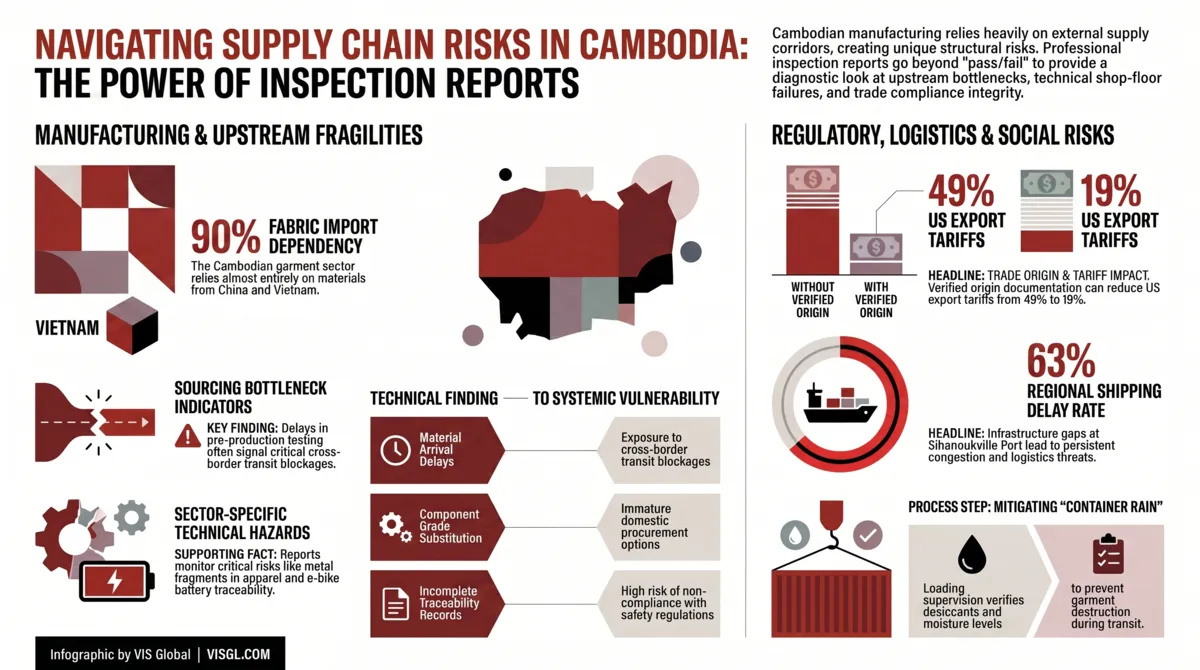
Sourcing diagnostics show that the Cambodian garment sector imports approximately 90% of its fabrics and accessories directly from China and Vietnam. Similarly, the rapidly expanding bicycle and electric bicycle assembly verticals show a near-total dependency on foreign supply bases, relying completely on imported high-value components such as specialized batteries, motors, and electronic controllers. When a Pre-Production Inspection or an Incoming Quality Control (IQC) report documents high component rejection rates, it indicates that the factory is struggling to manage its external logistics networks.
These cross-border vulnerabilities introduce immense operational risks for global brands during periods of regional geopolitical tension. Importers monitoring local factories must watch for specific sourcing bottleneck indicators that signal imminent delivery delays or compromised product quality. Sourcing teams can consult historical studies regarding challenges in the Cambodian garment value chain to understand how upstream supply fragilities directly degrade production predictability at the local level.
To help procurement divisions map and isolate these multi-tier structural threats, the primary sourcing bottleneck indicators identified during factory inspections are classified in the table below:
| Sourcing Bottleneck Indicators in Quality Reports | Technical Shop Floor Finding | Systemic Supply Chain Vulnerability |
| Material Arrival Delays |
Scheduled pre-production testing is postponed due to the physical absence of raw component batches. |
High exposure to cross-border transit blockages along land corridors or at Sihanoukville Port. |
| Component Grade Substitution |
The manufacturer attempts to utilize unauthorized alternative material grades or plastic resins without buyer consent. |
Immature domestic procurement options, forcing the factory to find local workarounds due to foreign supply delays. |
| High Incoming Rejection Rates |
Imported component batches fail initial mechanical, tensile, or chemical screening upon arrival at the warehouse. |
Deficient quality control management at the source country combined with a lack of preliminary screening by the factory. |
| Incomplete Traceability Records |
The factory is unable to supply valid chemical composition certificates or mill logs for imported metals. |
Total lack of control over upstream component vendors, escalating the risk of non-compliance with Western safety regulations. |
Read more:
- Common Quality Defects Found in Cambodia Garment Manufacturing
- Electronic Product Inspections in Cambodia: Key Quality Risks Importers Should Know
- Hardline Product Quality Control in Cambodia: What Buyers Should Verify Before Shipment
What Technical Quality Controls Are Revealed on the Factory Floor?
Technical quality controls on the factory floor are revealed through statistical Acceptable Quality Limit sampling schedules that classify product defects into critical, major, and minor tiers. These detailed metrics reflect the exact operational sophistication, machine calibration disciplines, and worker competencies of the supplier. Independent quality engineers apply standard international sampling tables to calculate precise batch acceptance or rejection parameters based on the specific total lot size.
In Cambodia’s high-volume manufacturing landscape, specific processing defects point directly to distinct operational failures inside the plant. Importers must look beyond basic pass or fail summaries to analyze the precise technical anomalies documented during active production runs. This granular tracking allows corporate sourcing teams to pinpoint whether a supplier is managing its manufacturing infrastructure effectively.
The technical parameters evaluated across primary Cambodian manufacturing verticals encompass several specialized checking sequences:
-
Apparel and Garment Metal Safety: For children’s wear and general apparel, the presence of sharp metal fragments or broken sewing needles constitutes a critical safety hazard. Compliant facilities enforce a strict used needle control policy where operators are barred from possessing spare needles, and all replacements are locked and logged by a shop supervisor. Final cleared garments must pass through a conveyor-type tunnel metal detector that undergoes a mandatory nine-point calibration check at the start, middle, and end of every shift.
-
Footwear Mechanical Durability Testing: Footwear quality control reports outline specific physical performance checks executed on the factory floor. These evaluations include upper-to-sole bonding adhesion tests, outsole flex resistance, and heel attachment strength. Inspectors utilize a zoning evaluation matrix where Zone A, the highly visible upper, carries a much lower tolerance for cosmetic blemishes than Zone B or Zone C.
-
Bicycle and E-Bike System Integration: The transition toward high-value electric bicycle assembly has exposed an engineering gap in many local facilities. Quality reports evaluate dielectric voltage withstand parameters, battery pack traceability, and functional firmware configuration logs. Frequent wiring harness failures or compromised waterproofing seals indicate that a supplier is operating as a basic assembly shop rather than a mature, technically integrated manufacturer.

How Do Quality Reports Validate Trade Compliance and Origin Integrity?
Quality reports validate trade compliance and origin integrity by verifying physical manufacturing records, raw component invoices, and product assembly markings to eliminate transshipment fraud risks. As global trade compliance oversight intensifies, independent third-party validation acts as a vital defensive line for international brands. Quality documents verify that the goods underwent substantial transformation within Cambodia rather than being illegally rerouted to evade punitive tariffs. Read more: How to Use SCARs to Improve Your Supply Chain Quality.
Regulatory compliance became a strict operational mandate following recent inter-ministerial decrees. Sourcing teams must ensure their local manufacturing partners strictly satisfy the Ministry of Commerce regulations on exports to the United States to secure a valid Origin Certification Letter. Under these joint frameworks, factories must undergo rigorous on-site audits by local authorities to prove that core components conform directly to verified local content thresholds.
Failing to maintain transparent origin documentation carries catastrophic financial and legal consequences for international buyers. The specific preferential tariff parameters governing major Western export corridors require continuous administrative tracking:
-
United States Customs Corridors: Under active reciprocal trade agreements, standard tariffs on verified Cambodian exports drop from 49% to 19%, provided that strict rules of origin are maintained and documented via physical factory tracking logs.
-
European Union General Scheme of Preferences: Standard bicycles face a steep 48.5% anti-dumping duty alongside a 10.5% base tariff. Conversely, advanced e-bikes remain duty-free under Generalized Scheme of Preferences rules, provided they contain at least 50% regional content, limit Chinese-origin parts to 20%, and utilize a frame fully manufactured within Cambodia.
Read more: How Inspection Reports Help Buyers Make Better Decisions
What Operational Risks Are Exposed by Social Compliance Diagnostics?
Operational risks are exposed by social compliance diagnostics through the identification of systemic overtime violations, wage calculation errors, and volatile labor relations that trigger high worker turnover and productivity declines. A supplier’s ethical performance record is directly linked to its technical stability and legal authorization to export. Under mandatory national monitoring initiatives, factory compliance mapping is legally enforced across all exporting facilities.
Independent auditors utilize specialized assessment tools to verify workspace environments. Procurement executives should reference the Cambodian compliance assessment tool clusters to understand how international labor standards categorize field findings across fundamental rights and general working conditions. When a social compliance report flags major non-conformities, it typically signals deep operational struggles hiding within the factory management structure.
The structural hierarchy used to classify social compliance risks and their operational consequences follows a rigorous diagnostic matrix:
-
Zero-Tolerance Violations: Immediate critical findings such as child labor, forced labor including debt bondage from unauthorized broker fees, document falsification, or active interference with the auditing process. These issues result in immediate contract termination and a total revocation of export privileges.
-
Major Non-Conformities: Serious systemic failures such as forced overtime exceeding legal limits, wages dropping below the statutory minimum, or missing emergency fire safety infrastructure. A factory that relies on systematic overtime is typically trying to compensate for poor production planning, excessive machine downtime, or low baseline labor productivity.
-
Minor Non-Conformities: Operational gaps such as incomplete training records, minor environmental paperwork omissions, or insufficient safety signage across transit lanes. While low risk, these items require structured corrective action plans to prevent progressive compliance degradation.
How Can Importers Manage Downstream Port Congestion and Logistics Threats?
Importers can manage downstream port congestion and logistics threats by executing strict Container Loading Supervision to audit the physical cleanliness, water resistance, and desiccant placement of shipping units prior to dispatch. A supplier’s operational responsibility does not terminate at the factory gate. For an export shipment to reach its destination successfully, it must navigate an internal logistics framework that is frequently prone to severe delays.
Sihanoukville Autonomous Port handles approximately 70% of Cambodia’s total import and export container volumes. Rapid commercial growth has outpaced local infrastructure expansion, pushing the terminal toward its maximum handling capacity and causing persistent congestion. Sourcing teams can review the Sihanoukville Port terminal development survey to analyze the physical capacity limitations, manual paperwork bottlenecks, and lack of integrated electronic data systems that cause approximately 63% of regional shipments to face delays.
Because of these extended port delays, cargo sitting inside steel containers faces extreme environmental exposure. During the wet, humid monsoon season, solar heating turns closed containers into high-humidity chambers, leading to ceiling condensation known as container rain that can destroy garments and footwear. Enforcing a rigorous container loading checklist represents an essential defensive strategy to guard against moisture contamination.
To ensure absolute cargo protection before logistics transfer, your independent inspection team must verify the following physical parameters:
-
Container Structural Integrity: Executing detailed interior and exterior reviews to confirm the steel unit is completely dry, clean, and entirely free of structural holes or rust.
-
Desiccant and Liner Deployment: Verifying that high-grade water-absorbent desiccants are suspended within the cargo space and that floor liners are correctly positioned.
-
Carton Moisture Meter Testing: Testing random export boxes with calibrated moisture meters to guarantee that cardboard moisture levels remain within safe boundaries.
-
Silica Gel Package Verification: Confirming that individual retail shoeboxes or sealed garment polybags contain active, functional silica gel packets.
Conclusions
An independent third-party inspection report serves as far more than a basic pass or fail transaction log. For global enterprises sourcing from Cambodia, these comprehensive documents connect minor micro-level defects on the shop floor with major macro-level supply chain and regulatory risks. Transitioning from a reactive quality review approach to an active, data-driven process control strategy allows brands to address structural vulnerabilities, optimize landed costs, and protect their long-term brand equity.
Contact VIS Global for quality control and inspection services in Cambodia.